
.svg)


Blog
Welcome to the Areeb Blog where tech gets real ideas get loud and jargon takes the back seat This isn't your average blog with dry updates and corporate fluff Here we drop smart insights with personality mixing innovation with just the right amount of attitude. So grab a coffee dive in and get ready to laugh learn and maybe even question everything you thought you knew about tech This is where Areeb's brain meets its blog voice and it's got jokes.
Looking Up: The Endless Wonders of the Sky Above Us
Jul 19, 2026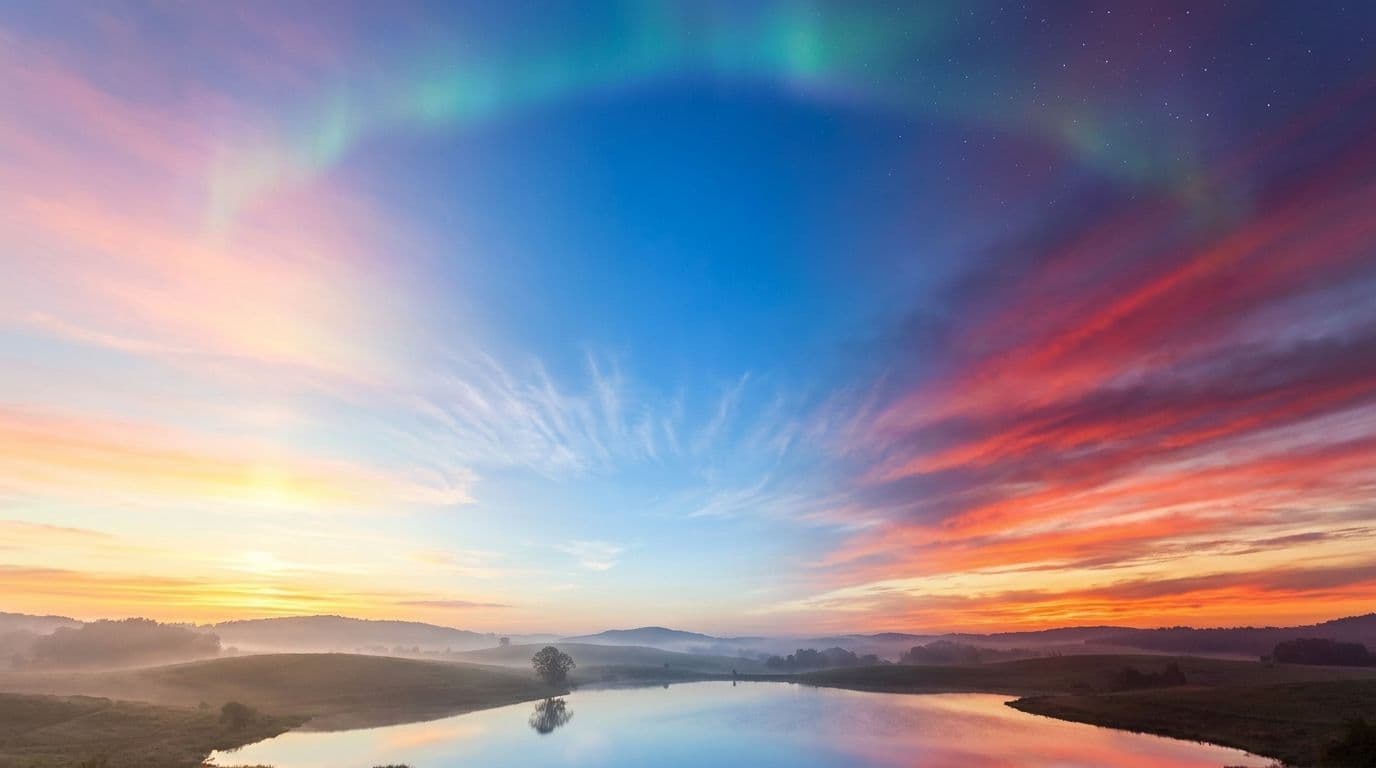
Every day we live beneath an immense, ever-changing canvas. Explore the science, beauty, and cultural meaning of the sky — from why it’s blue to auroras, sunsets, and the thin atmosphere that makes life on Earth possible.
Every day, we live beneath an immense, ever-changing canvas. The sky watches over us from the soft pastels of dawn to the deep indigo of night, hosting fiery sunsets, drifting clouds, and glittering stars. More than a pretty backdrop, the sky is Earth’s life-sustaining atmosphere—a thin, protective veil of gases that makes our world unique. Let’s explore the science, beauty, phenomena, and cultural meaning of this extraordinary domain.
Why Is the Sky Blue?
Sunlight appears white but contains every color of the rainbow. As this light enters Earth’s atmosphere, it collides with tiny gas molecules (mostly nitrogen and oxygen). This process, called Rayleigh scattering, preferentially scatters shorter wavelengths—blue and violet—in all directions.
Our eyes are more sensitive to blue than violet, and the Sun emits slightly less violet light, so the sky appears predominantly blue. The sky is actually closest to violet by pure scattering preference, but human vision and solar spectrum make blue dominant. Clouds look white because larger water droplets scatter all wavelengths equally.
Earth’s Atmospheric Layers
The atmosphere is a layered blanket held by gravity. From the ground up:
Troposphere (up to about 8–15 km): Where we live and breathe. Nearly all weather happens here—clouds, rain, storms. It contains most of the atmosphere’s mass.
Stratosphere (up to ~50 km): Home to the ozone layer, which absorbs harmful ultraviolet radiation. Commercial jets often cruise here in calmer air.
Mesosphere (up to ~85 km): The coldest layer. Most meteors burn up here as “shooting stars.”
Thermosphere (up to ~600 km): Extremely hot due to solar absorption, yet so thin you’d freeze. Auroras dance here when solar particles excite gases.
Exosphere: The gradual fade into space.
About 78% nitrogen and 21% oxygen make up dry air, with argon, carbon dioxide, water vapor, and aerosols completing the mix. This composition provides breathable air, traps heat for a habitable temperature (~15°C average), and filters radiation. Without it, Earth would suffer extreme day-night temperature swings and deadly UV exposure.
If you could drive straight up at highway speeds, you’d reach space in a little over an hour—the atmosphere is surprisingly thin.
The Magic of Sunrises and Sunsets
When the Sun is low on the horizon, its light travels through a much thicker slice of atmosphere. Shorter blue and green wavelengths scatter away almost completely, allowing longer reds, oranges, and yellows to reach our eyes. Extra particles from dust, pollution, or volcanic ash can intensify these fiery displays. The same physics that blues midday skies paints dramatic dawns and dusks.
Celestial Spectacles and Nighttime Marvels
The sky offers constant theater. Auroras (northern and southern lights) shimmer when charged solar particles collide with atmospheric gases. Meteors streak as space rocks vaporize. Rare noctilucent clouds glow electrically high in the mesosphere. At night, the black sky reveals stars, planets, the Milky Way, and human-made satellites. From space, Earth’s thin blue limb and glowing cities remind us how fragile and precious this envelope is.
The Sky in Culture and Myth
Across civilizations, humans have projected stories onto the heavens. Greeks saw myths in constellations; Egyptians tracked stars for Nile floods and deified the Sun as Ra; Indigenous cultures mapped seasonal cycles, navigation, and creation stories in the stars and Milky Way (sometimes a river, snow path, or trickster’s trail). The sky symbolized transcendence—immense, eternal, and divine—inspiring religion, art, architecture, and early science. Today, 88 official constellations form our shared celestial map, yet countless “sky cultures” saw different figures in the same stars.
Guarding Our Sky
Our atmosphere is delicate. Rising greenhouse gases, pollution, and ozone threats alter its balance, affecting climate, air quality, and health. Volcanic eruptions show nature’s power to cool or warm the planet temporarily through aerosols. Protecting air quality and the climate means protecting the sky we all share.
The next time you glance upward, pause. Whether clear blue, stormy gray, sunset-blazing, or star-strewn, the sky connects us to physics, planetary science, human history, and the simple joy of wonder. It is the breathable border between us and the cosmos—an everyday miracle worth understanding, cherishing, and safeguarding. Look up often. The greatest show on Earth is free, constantly changing, and happening right above your head.
Get in touch
Have a question or want to work with us? Send us a message and our team will get back to you.